
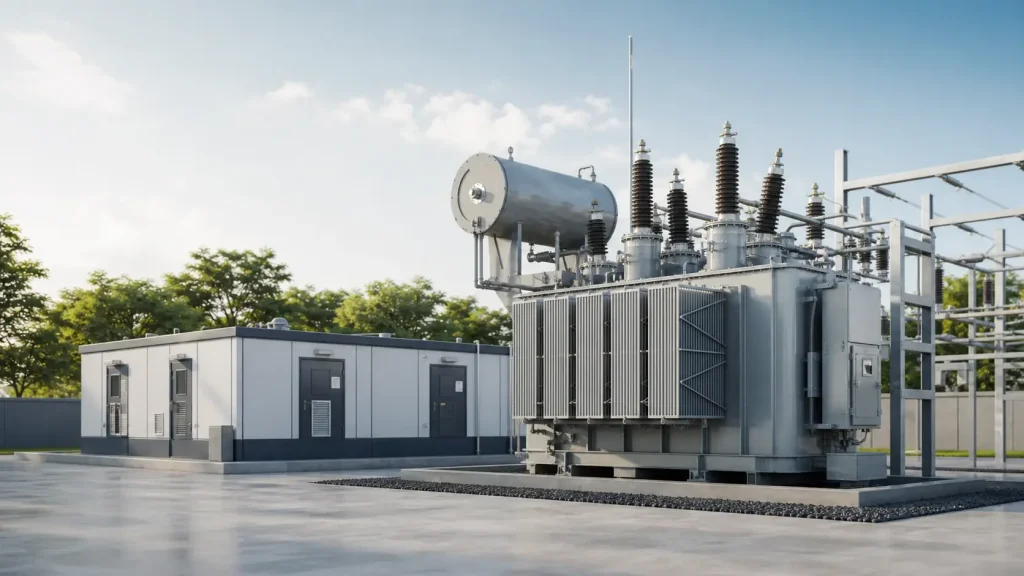
Transformer enquiries usually arrive as a single number – “we need a 1000 kVA transformer” – and that number is the least informative part of the specification. Two units with the same rating can differ in vector group, impedance, losses and standard, and any one of those will change whether the unit passes inspection on your site.
This guide is written for buyers and EPCs specifying distribution transformers, and it follows the order in which the decisions actually matter.
Rating is a thermal question, not a load number
kVA is what the transformer can carry continuously without exceeding its designed temperature rise. It is not the load you will draw. A distribution transformer feeding a commercial building with a diversified load is routinely sized at 60 to 80 per cent of connected load, because not everything runs at once.
Oversizing has a real cost: a transformer running at 30 per cent load still carries its no-load loss every hour of every day, and it costs more to buy. Undersizing shortens insulation life. The useful input is a load profile, not a peak number.
Vector group decides how it behaves on your network
The vector group describes the winding connection and the phase shift between primary and secondary. It is not an academic detail – it determines whether the transformer can be paralleled with an existing unit, and how earth faults behave.
Reference table
Swipe horizontally to view all columns →
| Vector group | Typical use | Why it is chosen |
|---|---|---|
| Dyn11 | Distribution, most common | Delta primary blocks triplen harmonics; 30 degree shift suits European and most IEC networks |
| Yyn0 | Small distribution, lighting | No phase shift; simpler for paralleling, but sensitive to unbalanced load |
| YNd11 | Step-up, generator and grid interface | Neutral on the HV side for earthing and protection coordination |
| Dyn5 | Where an existing unit must be matched | Used to parallel with older plant on the same bus |
If the transformer will run in parallel with anything already installed, the vector group is fixed by that unit. Say so at enquiry stage – it is expensive to discover later.
Impedance voltage sets the fault level
Impedance, given as a percentage, is the voltage required to circulate rated current on a shorted secondary. Typical distribution units sit at 4 to 6 per cent. It cuts both ways.
- Lower impedance gives better voltage regulation under load, but a higher prospective short-circuit current – downstream switchgear has to be rated for it.
- Higher impedance limits fault current and lets you specify cheaper downstream gear, at the cost of more voltage drop.
This is the one number that ties the transformer to the switchgear rating. They should be specified together, not quoted separately by two suppliers.
Losses: the part you pay for twice
A transformer has two losses. No-load loss (iron loss) is constant whenever the unit is energised, whether or not it carries load. Load loss (copper loss) rises with the square of the current.
For a transformer that sits energised at partial load, no-load loss dominates lifetime cost, and paying for a lower-loss core is usually recovered. Efficiency regulations – DOE in the United States, the EU Ecodesign tiers – set minimums by rating and type, so the compliant tier is not optional in those markets.
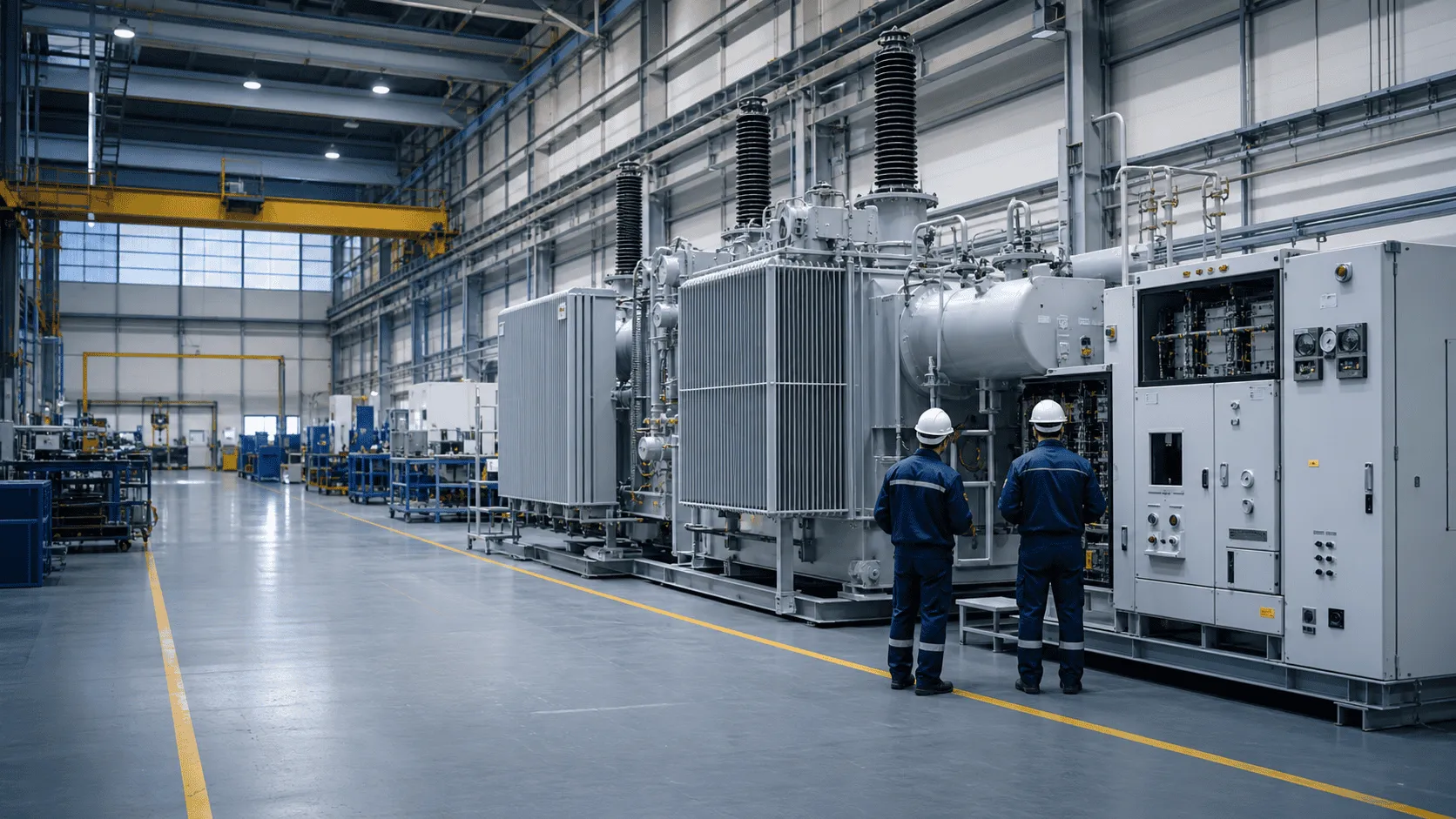
Oil-immersed or dry-type
The choice is driven by where the unit lives, not by preference:
- Oil-immersed is the economical choice outdoors and at higher ratings. It needs bunding or spill containment and periodic oil sampling.
- Dry-type cast resin is specified indoors, in basements, on roofs, and anywhere fire risk is the governing constraint. It costs more per kVA at the same rating.
We size and price both against the same duty so you can compare on total installed cost rather than unit price.
Cooling and what the letters mean
Cooling designations tell you how heat is removed and how much margin the unit has:
- ONAN – oil natural, air natural. Base rating, no fans.
- ONAF – oil natural, air forced. Fans add a second, higher rating, typically 25 to 40 per cent above ONAN.
- AN / AF – the dry-type equivalents.
Ask which rating is being quoted. “1000 kVA” is ambiguous if the unit is 1000 kVA ONAN and 1330 kVA ONAF.
IEC or ANSI: it changes the design, not just the paperwork
IEC 60076 and ANSI / IEEE C57 differ in rating series, temperature rise limits, impedance ranges, terminal arrangements and test sequences. A unit built to one is not a substitute for the other in most utility approval processes.
State the destination and the utility standard when you enquire. The unit is then designed and tested to it, and the test report matches what your inspector asks for.
What to send us to get an accurate quote
Five pieces of information turn a ballpark into a firm price:
- Rating in kVA and the load profile, not just the peak
- Primary and secondary voltages, plus taps if the supply is weak
- Vector group, or the existing unit it must parallel with
- Standard required: IEC 60076, ANSI / IEEE C57, or a specific utility specification
- Installation location – indoor, outdoor, roof, pad – and ambient conditions
For standard ratings, confirm current U.S. stock and dispatch timing for the selected model. Engineered configurations follow the agreed specification and production schedule, with delivery timing stated in the quotation.
Share your single-line diagram or load list and we will return a specification, a test scope and a delivery date you can plan against.
EXPLORE FURTHER
Related technical guides.
BUYER CHECKLIST
Buyer considerations for this scope
Which efficiency level and cooling class do you need?
US distribution transformers are specified against DOE efficiency levels, and the cooling class follows from the duty cycle and the site. Sound level is worth specifying too on urban or noise-sensitive sites, where it is often the complaint that arrives after energisation.
What installation conditions decide the enclosure?
Indoor or outdoor, padmount or substation type, NEMA enclosure rating, altitude, ambient temperature range, and seismic zone. Each of those changes the build, and altitude in particular is frequently overlooked until derating is raised.
What documents have to ship with it?
Routine test report, nameplate photograph, vector and wiring diagram, insulation and dielectric data, and the DOE compliance documentation. Lenders and inspectors ask for these years later, so they belong on the delivery checklist, not in a follow-up request.
PRACTICAL ANSWERS
Questions buyers ask about this
Is the kVA rating just the load?
No. The rating is a thermal question, chosen from the load profile and the diversity factor rather than from the connected load. A diversified commercial load is usually well below the sum of the connected equipment.
Why does the vector group matter?
It decides how the transformer behaves on your network, including whether it can run in parallel with an existing unit and how it handles harmonics and earth faults. Getting it wrong only shows up at energisation.
What impedance should we specify?
Typically 4 to 6 percent, chosen from the prospective fault level and from parallel operation. Lower impedance improves regulation but raises the fault current the downstream switchgear has to withstand.
Oil-immersed or dry-type?
Dry-type is specified indoors or wherever fire risk is the constraint. Oil-immersed is more economical outdoors at higher ratings. We size and price both so you compare total cost rather than unit price.