
B2B procurement FAQ
Answers for solar equipment buyers.
Practical guidance for solar installers, EPCs, contractors and distributors sourcing residential and commercial equipment through GTP Solar.
- Project-matched selectionEquipment, quantities and interfaces reviewed with your team
- U.S. warehouse inventoryDirect delivery to your specified U.S. location
- Documentation supportCertification documents for the selected equipment
Share your project location, quantities and target schedule — we confirm availability and a tailored quotation.
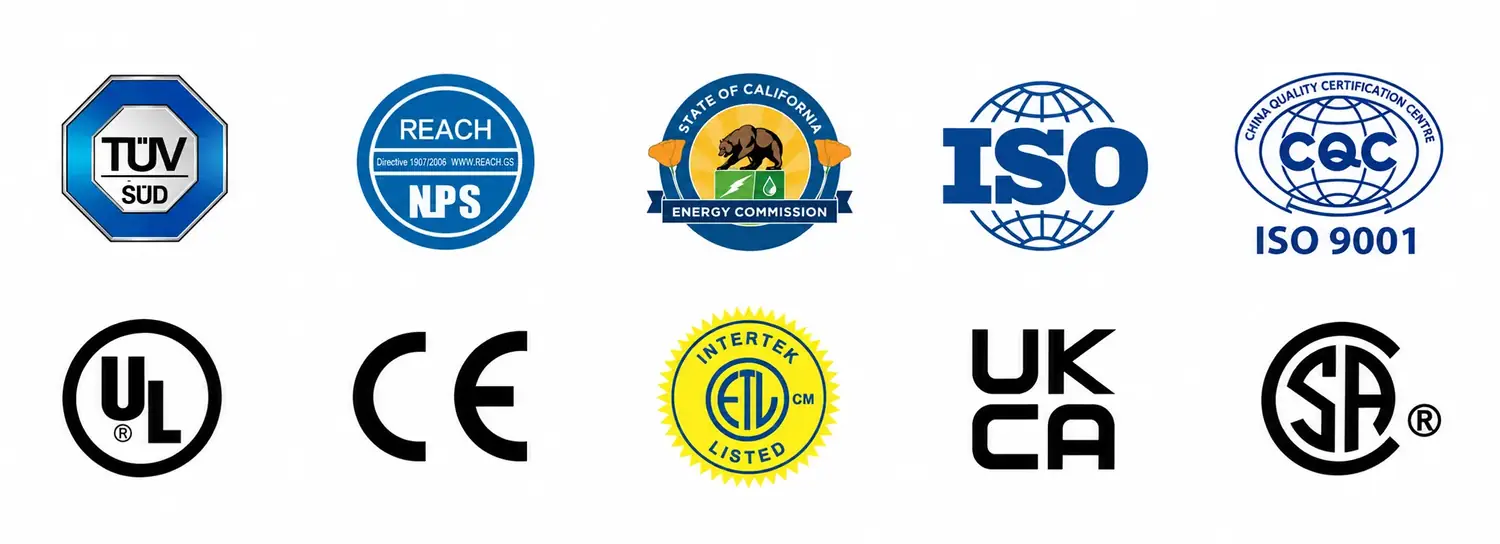
Product documentation
Certification documentation for the equipment you select.
We can provide product-specific certification and compliance documentation matched to the selected equipment and destination-market requirements.
Include your target market and documentation needs in the enquiry so the applicable documents can be confirmed with the equipment scope.Products & technical fit
What products can GTP Solar supply?
Subject to availability, we coordinate a one-stop supply of solar modules, inverters, energy storage systems, mounting equipment, transformers, switchgear and related solar/electrical materials for residential, commercial and specialized applications. Start with the full equipment range.
Can you help match equipment to our application?
Yes. Share the application, capacity or load profile, voltage requirements, desired products and destination. We can help align the equipment scope and available documentation with your project brief. Six application pages cover the common cases, from commercial and industrial through to off-grid sites.
Can you provide drawings or technical documents?
We provide complimentary system design support, together with agreed product information and technical documentation. Requirements vary by product and destination, so the deliverables are confirmed with the quotation. What ships with every order is listed under service quality.
Can you provide product certifications and compliance documents?
We can provide the product-specific certification and documentation applicable to the selected equipment and destination requirements. Please include your target market and documentation needs in the enquiry so they can be confirmed with the equipment scope. Certification is obtained for the destination before shipment; per-market detail is on each product category page.
Warehouse stock & delivery
Do you have inventory in the United States?
Selected products are available from U.S. warehouse inventory. Availability and quantity are confirmed for each enquiry before an order is agreed. Stocked lines and delivery windows are set out under service quality and delivery.
Can U.S.-stocked products ship to our specified location?
Yes. Where domestic stock is available, delivery can be coordinated to an agreed U.S. location. These domestic shipments do not create a new import process for the buyer. For anything that travels by sea instead, the container loading guide shows what fits in a 40HQ.
Do you supply projects outside the United States?
Yes. The United States is our primary market, and international B2B orders can be reviewed based on product availability, destination-market requirements and agreed delivery terms. Overseas orders are planned as sea freight — the paperwork sequence is in the import checklist.
Project support & responsibilities
Do you provide installation or construction services?
In California, yes. Our own licensed crew covers residential, commercial and industrial, utility-scale and off-grid installation inside our California service area around Arcadia. Outside California we supply equipment only, and on-site construction, electrical installation and grid interconnection are carried out by your own licensed local contractors. The scope of the California service, including its boundaries, is set out on the California installation page.
What support is available before an order?
We can review your product scope, technical interfaces, project documentation needs, availability and delivery expectations before commercial terms are finalized. For storage projects the fire code and UL 9540A question usually comes first — see the fire code compliance checklist.
Quotations & ordering
What information do you need for a B2B quotation?
Please provide product categories, model or technical requirements where known, quantities, destination, target delivery date and any documentation requirements. A bill of materials or single-line diagram is useful when available. A list of what actually moves the price helps you see which inputs you can influence.
How are lead time and commercial terms confirmed?
Availability, lead time, pricing, delivery arrangements and documentation are confirmed in writing for the specific equipment scope before an order is placed. Stocked lines can ship in as little as seven days; engineered items such as switchgear are given a dated commitment from drawing approval.
Warranty, claims and service
What happens if equipment fails inside the warranty period?
For modules, a replacement is shipped first and the factory claim is settled afterwards — you are not asked to wait for the claim to close before the array is producing again. Inverters carry a ten-year warranty, storage ten years, mounting fifteen years, and transformers 24 months from commissioning or 36 months from dispatch, whichever is longer. The commitments are stated in full under service quality and claims.
How is a warranty claim evidenced?
Every module ships with a flash test report and every batch is supplied with EL images, so a claim is evidenced against records taken before dispatch rather than against an inspection carried out years later. The sequence, and what voids a claim, is set out in the module warranty claims guide.
Do you issue project-specific structural calculations for mounting?
Yes — a calculation for the project’s wind, snow and seismic zone, not a generic load table. Designs can be taken to 60 m/s wind speed where the site requires it. See mounting systems, and the load calculation method if you want to check the numbers yourself.
What is covered on the service side?
Documents shipped with every order, warranty and claims handling, compliance support and delivery are each defined in writing under service quality. Anything a specific order cannot meet is excluded at quotation stage rather than discovered after delivery.
Certification, compliance and freight
Which certifications are supplied with the equipment?
Certification is obtained for the destination market before shipment — UL or ETL for North America and TÜV or Intertek for Europe on modules; IEC 62619, UL 1973, UL 9540 and UL 9540A plus UN 38.3 on battery storage. The list is stated per order against the model actually supplied, not against a catalogue.
Who handles lithium battery transport compliance?
For US domestic movement we handle it — DOT and HMR rules, compliant packaging and labelling, and carrier selection. For sea freight, the UN number, packing instruction and any state-of-charge requirement are confirmed for the exact model before production starts, because that classification gates the booking. The freight side is worked through in the container loading guide.
Can you help with US import documentation?
We supply the document set that travels with the goods and the certificates for the model shipped. Classification, duty and trade remedies sit with the importer of record. What has to be evidenced, and in what order, is in the US import checklist.
What sourcing rules do US buyers have to document?
Sourcing-rule documentation is a live requirement on US projects and it changes. The evidence buyers are asked for, and how it is assembled, is covered under FEOC sourcing rules. Confirm the current position with your own counsel before relying on any supplier statement, including this one.
Sizing and selection
Can you help size a commercial system?
Yes. Send the load profile, the available roof or ground area and the operating pattern, and the array and storage sizing come back with the quote. The method, including how to avoid over-sizing storage, is in sizing solar plus storage.
How is inverter capacity chosen?
By DC-to-AC ratio, string current limits and whether clipping is intended — not by matching the array nameplate to the inverter nameplate. The trade-off, and when clipping is deliberate, is worked through in the inverter sizing guide.
How do we model payback honestly?
Build it from the load profile and the tariff structure, with degradation and availability stated rather than assumed away. A model that cannot be audited by the person signing the cheque is not a model. The worked approach is in commercial solar payback.
What changes for coastal or industrial sites?
Corrosion class drives coating specification, fastener grade and inspection interval, and the failure is usually local — a cut edge or a fastener head — rather than general thinning. Specification and verification are covered in coastal and industrial corrosion.
EXPLORE FURTHER