

Residential solar · Home energy storage
Residential Solar & Home Energy Storage
Matched equipment for installers delivering rooftop solar, hybrid backup and practical home energy storage.
- Project-matched selectionEquipment, quantities and interfaces reviewed with your team
- U.S. warehouse inventoryDirect delivery to your specified U.S. location
- Documentation supportCertification documents for the selected equipment
Share your project location, quantities and target schedule — we confirm availability and a tailored quotation.
Equipment scope
Make the home energy package work as one system.
We help professional buyers bring modules, hybrid inverter control, storage and mounting requirements into one clear equipment brief before quotation.
Solar modules
Rooftop module formats and power classes suited to the available roof area.
Hybrid inverters
Conversion and backup configurations matched to loads and service voltage.
Home storage
LiFePO4 battery options for backup duration and household demand.
Before quotation
Confirm the project conditions first.
Supply scope: equipment selection, material supply and documentation coordination. Permitting and site installation are completed by the buyer’s qualified installer or contractor where required.
- Roof layout, usable area and preferred module footprint.
- Expected loads, backup requirement and service voltage.
- Quantity, delivery location and requested delivery date.
Residential project matching
Build the home energy package around the household, roof and backup goal.
Each residential project has a different roof, electrical service and household load pattern. We help installers align the right equipment path to the homeowner’s actual energy and backup requirements.
Home & roof
Usable roof area, shading considerations, module layout and the available installation envelope.
Energy & backup
Household loads, critical circuits, desired backup duration and the energy-management objective.
Service & delivery
Service voltage, local requirements supplied by the buyer, product documents and delivery destination.
Configuration context
A home energy brief starts with the way the household uses power.
Installer-led projects benefit from a clear view of roof area, household loads, critical circuits and backup expectations. Those conditions determine the useful equipment path for that home.
- Project inputRoof layout and available module area
- Energy goalCritical loads and backup duration
- System fitService voltage and installation envelope
System overview
See the home energy system as one coordinated scope.
A clear view of the module, inverter, battery, grid and EV-charging path helps shape the right package. Final equipment selection is still confirmed against the roof, service conditions and project requirements.
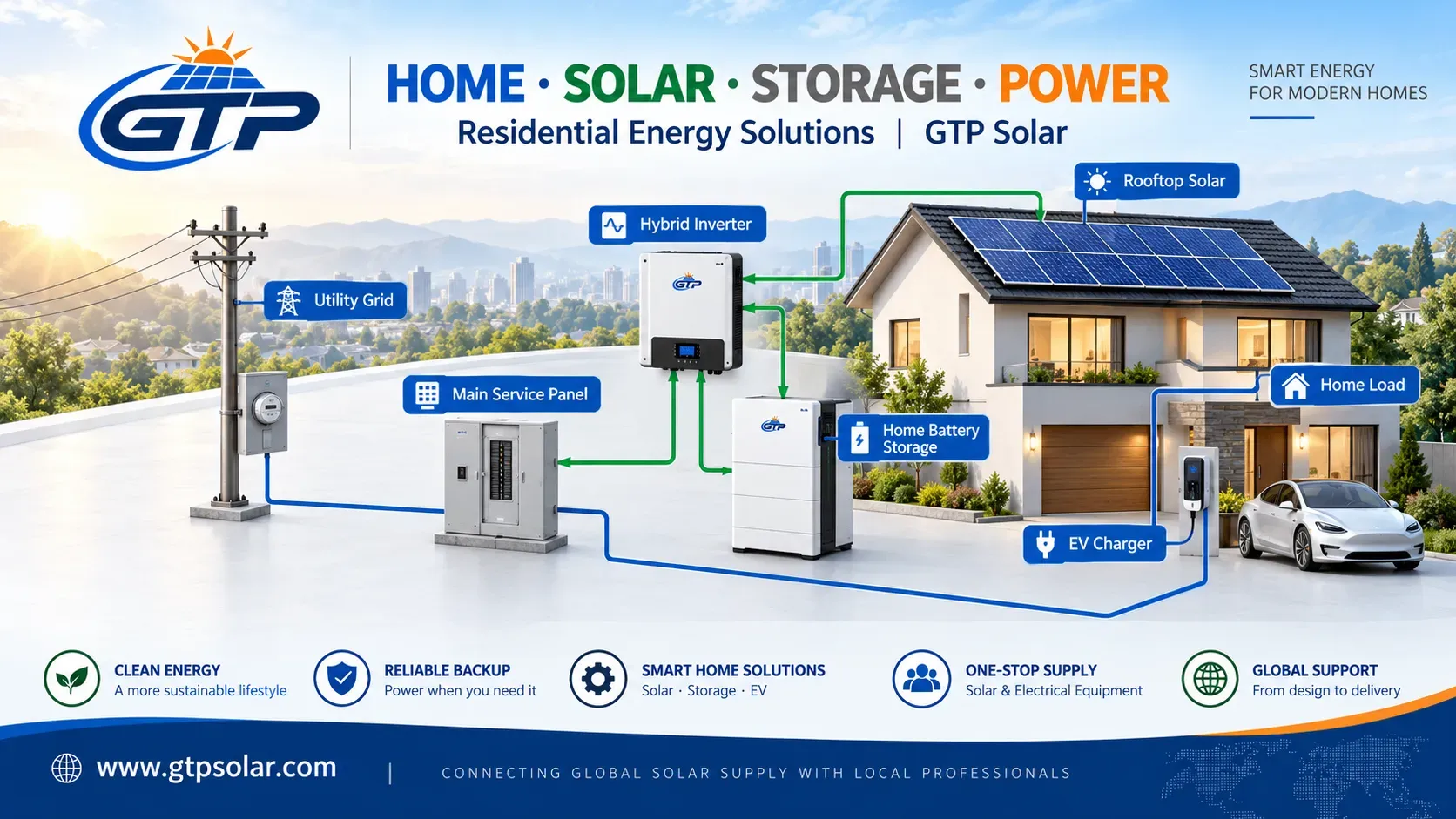
APPLICATION ENGINEERING
Typical home package configuration
Indicative ranges for a single-family home package. We confirm the final configuration against your roof geometry, service panel rating and the circuits you want on backup.
Illustrative selection information. Confirm the final specification for your model, site and delivery scope.
View full configuration & sizing factors
| Item | Typical specification | What decides it |
|---|---|---|
| Rooftop array | 6 to 14 kW across one or two roof faces | Usable roof area, shading, setback rules |
| Modules | 440 to 600 W, up to 23.5% module efficiency | Roof shape and rail layout, not just wattage |
| Hybrid inverter | 5 to 12 kW, 2 to 3 MPPT, split-phase 120/240 V | Backup load and service panel rating |
| Home battery | 10 to 30 kWh usable LFP, up to 8,000 cycles | Which circuits run on backup, and for how long |
| Monitoring | Per-string and per-battery telemetry | Warranty records and remote diagnostics |
Indicative ranges for enquiry planning. Final values follow the site review and are confirmed in writing on your quote.
What usually goes wrong on this kind of project
- Battery sized on total household consumption instead of on the circuits that must stay on – backup hours come out far shorter than expected.
- Inverter output does not match the existing service panel, so a panel upgrade appears mid-install.
- Roof clamps over-torqued during installation, cracking module frames – frame damage is excluded from the module warranty.
- Storage sited without checking what the local authority requires for residential batteries.
Questions buyers ask
How long will the battery run the house?
Backup duration depends on the power drawn by the backed-up circuits, not on the battery kWh alone. We size from your circuit list.
Can it work with an inverter we already own?
Sometimes. It depends on the communication protocol, the DC voltage window and the battery chemistry. Send the model numbers and we will confirm before you order.
Does the roof need penetrations?
It depends on the roof covering. Standing-seam metal usually takes non-penetrating clamps; tile and shingle roofs need flashing. We get the roof manufacturer position in writing.
How quickly can a package ship?
Stocked specifications ship from U.S. warehouse inventory, as fast as 7 days to your address.
Send roof photos, a recent utility bill and the list of circuits you want on backup.
Solar modulesHybrid invertersHome battery storageWhat installers should specify for homesSend your requirements
EXPLORE FURTHER