
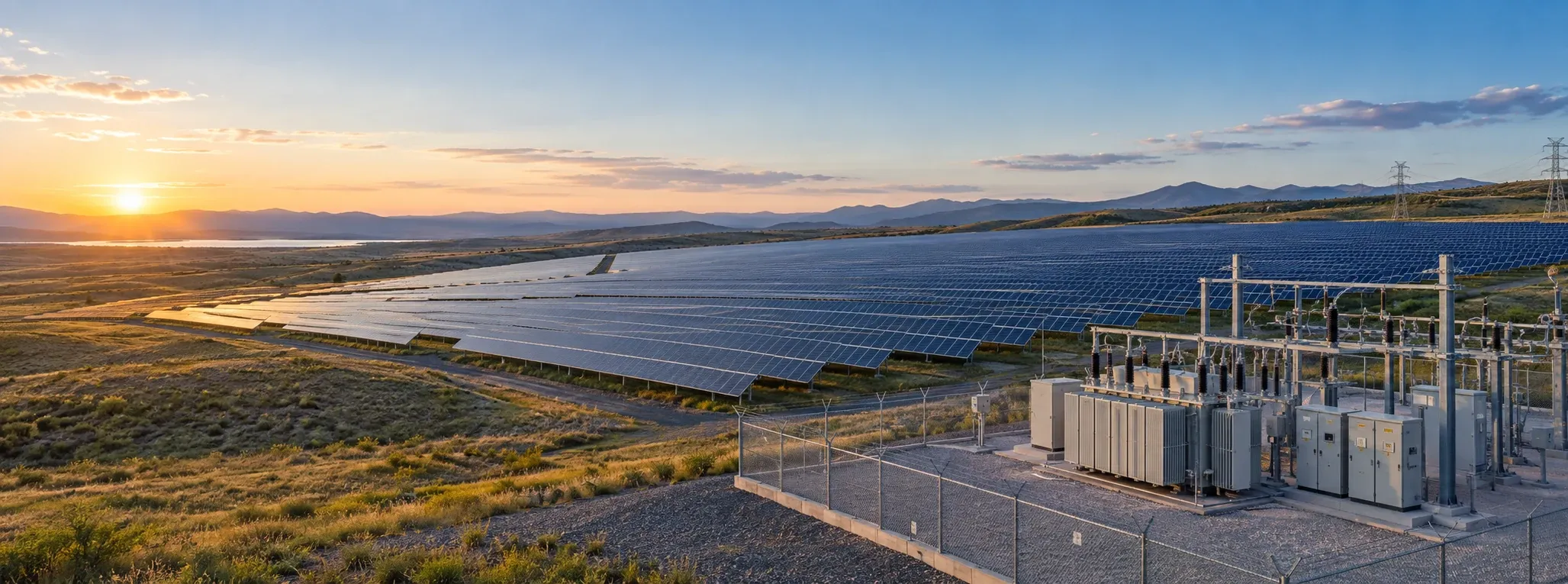
Utility-scale solar · Grid infrastructure
Utility-Scale Solar & Grid Infrastructure
Supply coordination for solar-farm, transformer and switchgear packages serving larger grid-connected projects.
- Project-matched selectionEquipment, quantities and interfaces reviewed with your team
- U.S. warehouse inventoryDirect delivery to your specified U.S. location
- Documentation supportCertification documents for the selected equipment
Share your project location, quantities and target schedule — we confirm availability and a tailored quotation.
Equipment scope
Set the supply scope before the delivery sequence.
Utility projects depend on compatible grid-side equipment, clear documentation and planned delivery. We support buyers building a coordinated package around those conditions.
Array equipment
High-volume module supply matched to array layout and project schedule.
Transformers
Distribution and power transformer options for solar and substation scope.
Grid interfaces
Switchgear and distribution equipment for protection and interconnection.
Before quotation
Confirm the project conditions first.
Supply scope: equipment selection, material supply and documentation coordination. Permitting and site installation are completed by the buyer’s qualified installer or contractor where required.
- Single-line diagram, design voltage and interconnection requirements.
- Array capacity, equipment schedule and preferred delivery sequence.
- Receiving constraints, destination and documentation requirements.
Utility project matching
Coordinate utility supply around the grid design and delivery sequence.
Utility projects require a matched package across the array, transformation and grid interface. We help translate the project documents and construction sequence into a coordinated equipment supply scope.
Grid design inputs
Single-line diagram, capacity, voltage, interconnection requirements and protection approach.
Supply sequence
Array quantities, transformer and switchgear scope, delivery phasing and receiving constraints.
Project assurance
Requested product documents, destination-market requirements and commercial terms confirmed for the order.
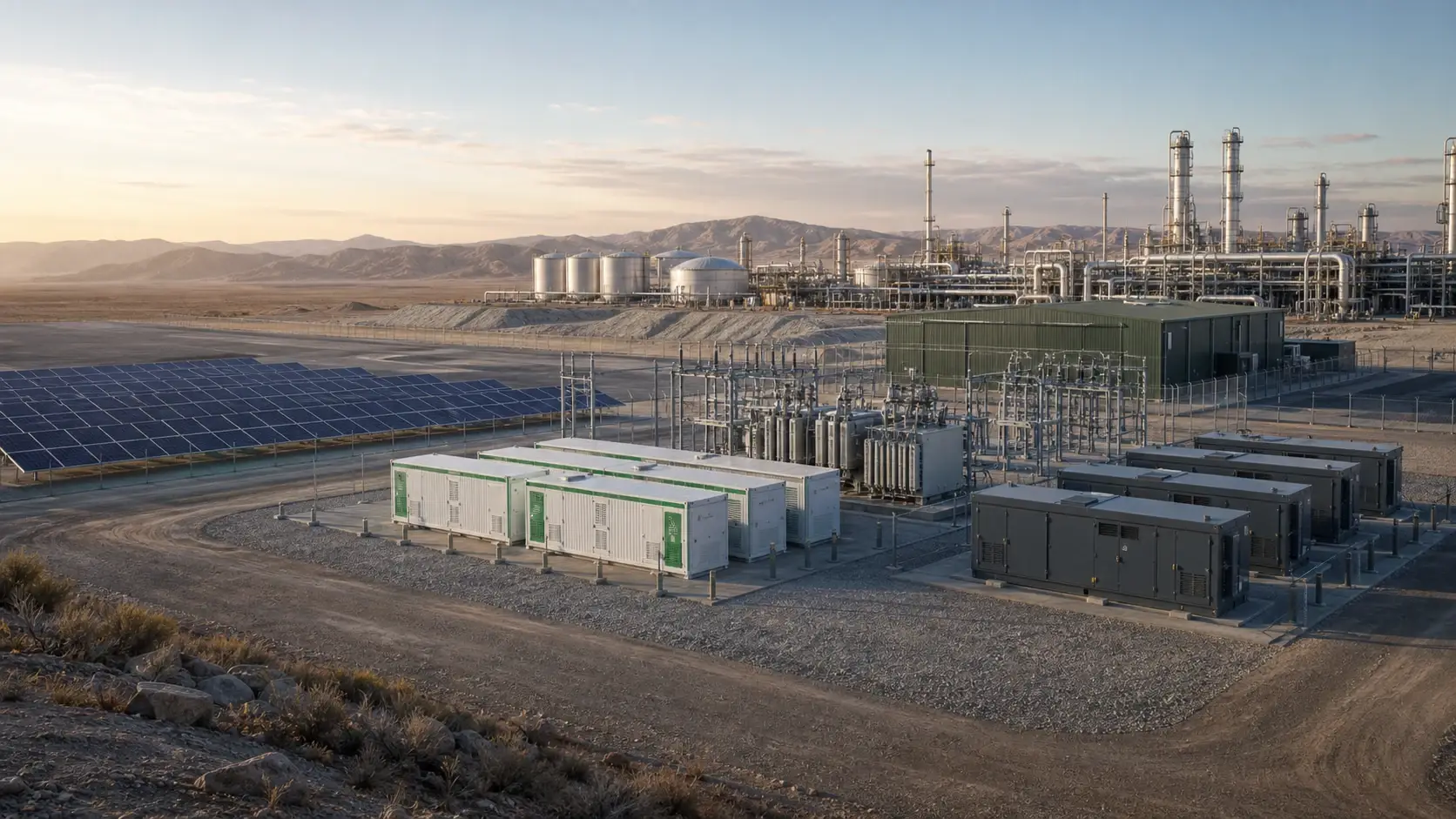
Configuration context
Align array, transformation and grid interfaces from the start.
Large projects move more smoothly when the electrical design, documentation needs and receiving sequence are reflected in one supply plan. We use those project inputs to match equipment categories and timing.
- Project inputSingle-line design and capacity target
- Grid fitInterconnection and protection requirements
- Supply planDelivery phasing and site receiving constraints
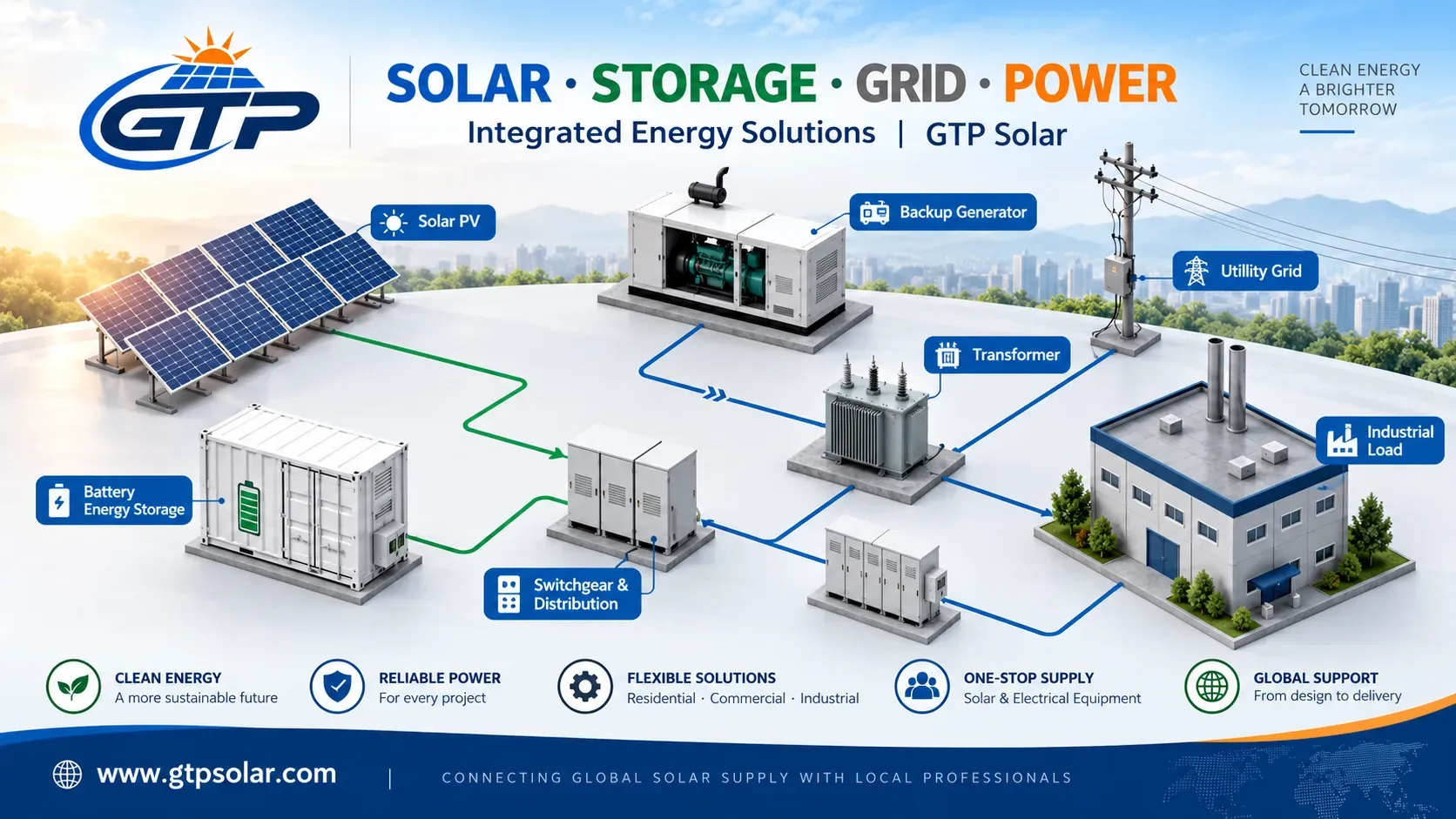
System overview
See the grid-connected energy system as one coordinated scope.
This overview brings solar PV, storage, transformation, distribution and grid interfaces into one discussion. The final supply scope is then aligned to the electrical design, interconnection requirements and delivery sequence.
APPLICATION ENGINEERING
Typical utility-scale supply scope
Indicative ranges for ground-mount and grid-interconnection projects. The supply sequence is built around your construction milestones, not around a single delivery date.
Illustrative selection information. Confirm the final specification for your model, site and delivery scope.
View full configuration & sizing factors
| Item | Typical specification | What decides it |
|---|---|---|
| Array size | 1 MW upward, released in blocks | Construction sequence and laydown area |
| Modules | 600 to 720 W, up to 23.5% module efficiency | Tracker or fixed structure, string voltage |
| Inverters | Central inverters or high-capacity string units | Block layout, O and M strategy |
| MV transformer | 2,500 to 10,000 kVA, ONAN or ONAF cooling | Step-up requirement and grid code |
| MV switchgear | Up to 31.5 kA short-circuit withstand | Fault level from the network operator |
| Mounting | Fixed tilt or single-axis tracker | Land shape, yield model, O and M capability |
Indicative ranges for enquiry planning. Final values follow the site review and are confirmed in writing on your quote.
What usually goes wrong on this kind of project
- One delivery date agreed instead of a milestone-based release sequence, which overloads site laydown.
- Transformer impedance and switchgear ratings sourced from different suppliers and never reconciled.
- Tracker stow wind case left out of the foundation design, then discovered during a weather event.
- Grid-interconnection documentation (IEEE 1547 / UL 1741 conformance) incomplete, holding up energisation.
Questions buyers ask
Can you deliver against our construction schedule?
Yes. We agree block releases against your milestones so equipment arrives as each section is ready, not all at once.
Should the transformer and switchgear come from one supplier?
We recommend it. Impedance, fault level and protection discrimination have to be consistent, and two separate quotes rarely are.
Tracker or fixed tilt?
Trackers raise yield but add drives, controllers and a stow wind case. Fixed tilt stays the default where land is tight or O and M resource is limited.
What test documentation ships?
Nameplate data and test reports to the applicable IEC or ANSI / IEEE standard, with drawings issued for approval before production.
Send the single-line diagram, the grid operator interconnection requirements and your milestone schedule.
Distribution and power transformersMV and LV switchgearMounting structuresCommissioning checks before sign-offSend your requirements
EXPLORE FURTHER