
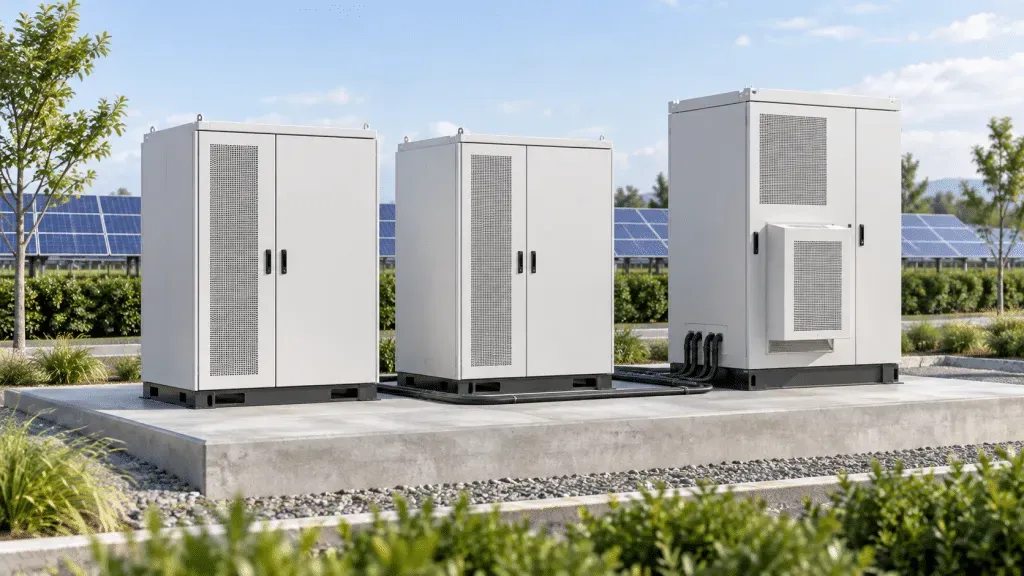
Storage quotations are easy to compare on one number and hard to compare on the thing that matters. A 500 kWh system from one supplier and a 500 kWh system from another can differ by years of service life, by a third of usable energy, and by whether they can shave a demand peak at all. The nameplate kWh tells you almost nothing on its own.
This guide is written for buyers specifying commercial and industrial storage – installers, EPCs, and facility teams who have to turn a requirement into a purchase order. It follows the same sequence we use when a customer sends us a load profile and asks what to buy.
Separate energy from power, and name the C-rate
The first two numbers to fix are how much energy the battery holds (kWh) and how fast it can deliver it (kW). They are independent, and confusing them is the most common specification error we see.
- Energy (kWh) determines how long the system can run a load or cover a gap.
- Power (kW) determines whether it can cover that load at all – a 100 kW peak cannot be shaved by a battery limited to 40 kW, no matter how much energy it holds.
- C-rate is the ratio between them. 500 kWh at 0.25C delivers 125 kW; the same 500 kWh at 0.5C delivers 250 kW but will usually carry a shorter cycle-life warranty.
State all three in the enquiry. A supplier quoting only kWh will fill in the power rating themselves, and it will be the cheapest one that still technically satisfies the brief.
Usable capacity is not nameplate capacity
Almost every commercial battery is specified with a depth of discharge (DoD) limit, and the warranty is written against cycles taken within that limit. A battery sold as 100 kWh with a 90% usable window gives you 90 kWh of working energy. The same module sold with an 80% window gives you 80 kWh – a 12% difference in delivered capability for an identical nameplate.
Ask two questions in writing: what is the usable energy per cycle under the warranty terms, and what is the usable energy at end of warranty life. Capacity fades. A system that starts at 90 kWh usable and is warranted to 70% retention ends its warranty life nearer 63 kWh, and the business case should be modelled on the second number, not the first.
Read the cycle-life warranty properly
Cycle-life warranties are where commercial storage deals are won and lost, and the headline number is rarely the one that applies to your project. Look for:
- The cycle definition – is a “cycle” a full 100% equivalent discharge, or does the supplier count partial cycles differently?
- The throughput cap – many warranties are written as “X cycles or Y MWh of cumulative throughput, whichever comes first”. High-cycling applications hit the throughput limit long before the cycle count.
- The operating envelope – warranties commonly void above a specified ambient temperature or below a minimum state of charge.
- The retention guarantee – usually 60-70% of original capacity at the end of the term. Below that, the replacement obligation should be explicit.
Chemistry: why LFP became the default
Lithium iron phosphate (LFP) is now the default chemistry for stationary commercial storage, and for good reasons that matter to a buyer rather than a chemist: a longer cycle life than nickel-based chemistries under daily cycling, a safer thermal behaviour, and no reliance on cobalt supply. There are still applications where a nickel-based chemistry earns its place – where energy density and footprint are the binding constraint rather than cycle life – but for a fixed commercial installation, LFP is the conservative specification, and conservative is usually correct.

Thermal management and enclosure rating decide where it can live
A battery cabinet is a piece of equipment that has to survive a location. Two specifications decide whether it will:
- Thermal management – forced-air cooling is cheaper and adequate in temperate climates; liquid cooling holds cell temperature spread tighter, which matters for high C-rate cycling and hot sites. Cell temperature spread, not average temperature, is what ages a pack unevenly.
- Enclosure rating – IP54 is the usual indoor/ sheltered baseline; IP55 or higher for outdoor installations; and a corrosion class rating if the site is coastal or industrial. Outdoor siting also changes the fire-safety and setback conversation with the local authority.
Safety and certification: ask before you buy, not after
Storage is the part of a solar project that fire authorities and insurers ask the most questions about. Before issuing a purchase order, confirm the system carries certification to the standards your market recognises – cell and module level (commonly UL 1973 / IEC 62619) and system level (commonly UL 9540 with UL 9540A thermal propagation test data).
Ask for the actual test reports, not a certificate cover page, and ask what the installation manual requires for clearances and suppression. If your market requires a specific listing for interconnection or incentive eligibility, confirm it in writing before the container ships – not after.
The controller matters as much as the cells
A battery is only as useful as the controller operating it. Peak shaving, self-consumption and backup are three different control behaviours, and not every EMS does all three well.
Confirm that the energy management system can act on your meter data at the interval your tariff requires, that it exposes the data your team needs (not only a vendor app), and that setpoints can be changed locally without a factory call.
Where the battery is being added to an existing PV plant, confirm whether the architecture is AC-coupled or DC-coupled and which controller owns the decision-making.
What to put in the specification
Reference table
Swipe horizontally to view all columns →
| Item | Specify | Why it changes the outcome |
|---|---|---|
| Energy | Usable kWh at beginning and end of warranty | Nameplate overstates delivered energy |
| Power | Continuous kW and C-rate | Decides whether peaks can be shaved at all |
| Cycle life | Cycles and throughput cap, whichever first | High-cycling sites hit throughput first |
| Chemistry | LFP (default) with reason if otherwise | Cycle life, safety, supply risk |
| Thermal | Air or liquid, with ambient operating range | Cell spread drives uneven ageing |
| Enclosure | IP rating and corrosion class | Determines indoor vs outdoor siting |
| Compliance documents | UL 1973 / IEC 62619 / UL 9540 + 9540A data | Insurer and AHJ approval |
| Controller | Operating modes, meter interface, data access | Cells cannot deliver a strategy |
All of the above applies to a residential job too, but the emphasis shifts: usable capacity and backup behaviour matter more than C-rate, and it is the installer who has to explain the trade-off to the homeowner. The residential version is set out in what installers should specify for residential solar + battery.
Where to go from here
If you are sizing storage alongside a new array, start with the load profile rather than the roof – the sequence in our commercial sizing guide covers that step. You can review the storage configurations we supply on the energy storage page, or see how storage is applied in a commercial context on the commercial and industrial solar page. If you have interval data and a target outcome, send it through the enquiry form and we will come back with a specification rather than a catalogue.
PRACTICAL ANSWERS
Questions buyers ask about this
Usable or nameplate capacity?
Always specify usable. Nameplate is the cell capacity; usable is what the battery management system lets you draw, and the difference is usually 5 to 10 percent. A quotation compared on nameplate is not comparable.
What does the C-rate change?
Power. A 1 MWh system at 0.5C delivers 500 kW; the same capacity at 0.25C delivers 250 kW. If the application is peak shaving, the C-rate and the duration matter as much as the kWh.
How should the cycle-life warranty be read?
Against the depth of discharge and the temperature it is quoted at. Up to 8000 cycles at 80 percent depth of discharge is the usual LFP figure, and the warranty should state which of those two was tested.
Why is LFP the default?
It is thermally more stable, has a long cycle life and does not need cobalt. For stationary storage the energy density penalty does not matter, because there is no weight or volume constraint as there is in a vehicle.
EXPLORE FURTHER