
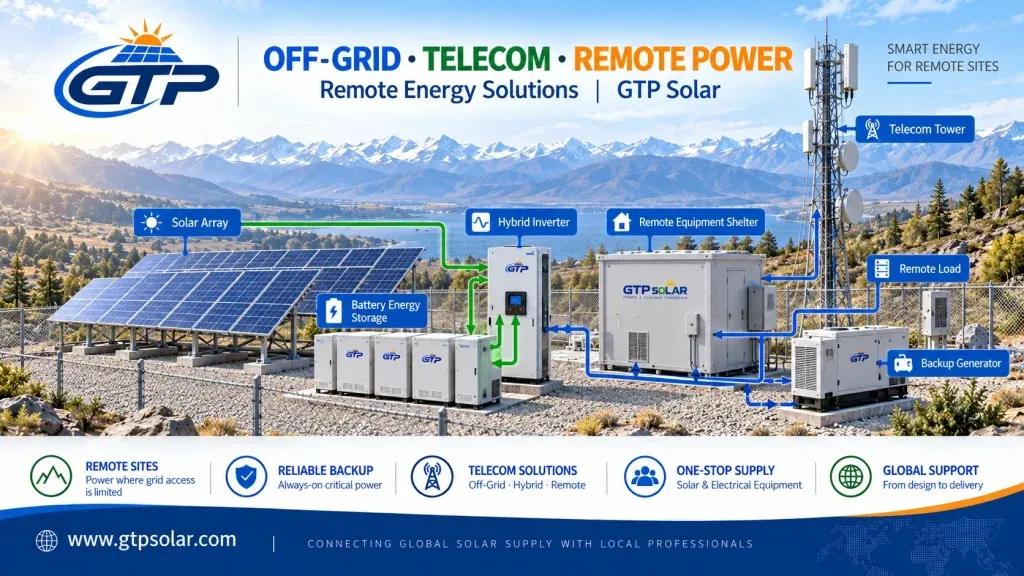
A remote telecom site does not need a clever system. It needs one that is still running eighteen months later, after a week of bad weather and with nobody on site. That requirement drives almost every specification decision, and it is why off-grid equipment lists look different from the residential and commercial ones.
This is a checklist for operators, integrators and contractors specifying solar and battery power for off-grid, telecom and remote monitoring sites.
Start from autonomy, not from panel count
The design question is never “how many panels”. It is “how many days of no sun must this site survive, at what load, and with what battery reserve at the end of it”. That is autonomy, and it sets the battery bank size first; the array is then sized to recharge that bank within the available solar window.
Get three numbers before anything else:
- Continuous load (W) – radio, router, monitoring, cooling if any. Measure it; do not take the nameplate.
- Required autonomy (days) – driven by site criticality and how quickly a crew can reach it.
- Worst-month solar resource – not the annual average. Design to the worst month, or the site will fail in the season you least expect.
MPPT controller sizing has its own rules
Charge controllers on remote sites are frequently undersized, and not in the obvious way. Two constraints matter:
- Input voltage window – the array’s open-circuit voltage at the coldest expected temperature must stay under the controller’s maximum. Cold panels produce higher voltage, and this is a common cause of controller failure on mountain sites.
- Output current – size to the battery charging current, and leave headroom. Controllers run hot at continuous rating in unventilated enclosures.
String configuration follows from this: series cells to stay inside the voltage window, parallel strings for current. Get this wrong and the controller either clips or trips.
Battery chemistry: why LiFePO4 has largely taken over
Lead-acid still appears in legacy specifications, but for remote sites LiFePO4 has become the default for reasons that are practical rather than fashionable:
- Far more usable capacity at the same nameplate rating – deep cycling does not destroy it the way it destroys flooded cells.
- Tolerates partial state of charge, which is exactly how solar sites behave in winter.
- No routine watering or equalization visits, which on a remote site is the largest hidden operating cost.
- Wider operating temperature range, though cold-temperature charging limits still apply and must be respected.
See our battery energy storage range, and the inverters and charge controllers category for MPPT options.
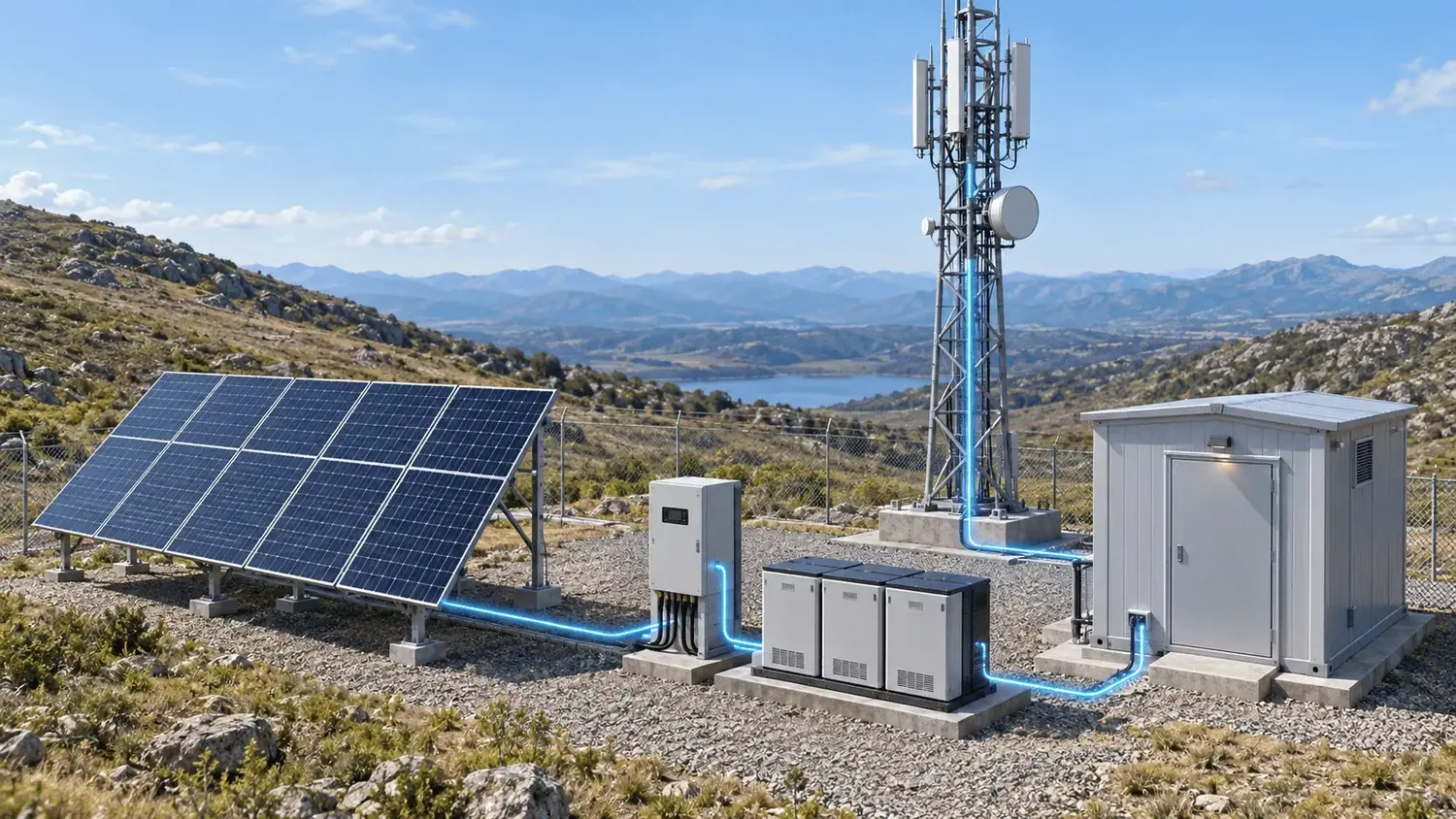
Enclosure and environment are specification items, not accessories
Remote site failures are far more often environmental than electrical. Specify explicitly:
- Ingress protection – dust and driving rain, not just “outdoor”.
- Operating temperature range – including the low-temperature charge cut-off on the battery.
- Ventilation or thermal management – an enclosure in full sun can run far above ambient.
- Corrosion – coastal sites need marine-grade finishes and hardware.
- Security and access – lockable, serviceable, and arranged so a technician can work without dismantling half the system.
Do not forget the easy-to-miss items
- Surge and lightning protection – remote elevated sites are exposed by definition.
- Proper DC disconnects and fusing at both array and battery.
- Spare capacity in the controller and enclosure for a future load increase.
- Remote monitoring with a defined alert path – so a failing site is found by telemetry, not by a customer complaint.
- Documentation and labelling that a technician who has never seen the site can follow.
Once a site has generation, storage and a generator running together, something has to decide which source runs when. That is the controller, not the inverter — and sizing it is a separate exercise, covered in how to specify a microgrid controller.
Equipment list for a typical off-grid telecom site
Reference table
Swipe horizontally to view all columns →
| Item | Driven by |
|---|---|
| PV array | Worst-month resource, recharge window, mounting surface |
| MPPT controller | Cold-temperature Voc, charging current, headroom |
| Battery bank | Autonomy days, usable depth of discharge, temperature limits |
| Inverter / DC-DC | Load voltage and waveform, surge requirement |
| Protection and disconnects | Fault levels, serviceability, surge exposure |
| Enclosure | IP rating, thermal load, corrosion class, security |
| Monitoring | What must be alarmed, and to whom |
More detail on configuration is on our off-grid, telecom and remote power page.
Specifying for a remote site?
GTP Solar supplies equipment for off-grid and telecom projects from US stock, with installation scope and any required licensed contractor confirmed separately for the project location. Send the site load, required autonomy days and location climate, and we will put together a specified equipment list with availability confirmed.
Request a quote for off-grid equipment, or browse all equipment categories.
BUYER CHECKLIST
Buyer considerations for this scope
What is the autonomy target and the worst-case load?
Design against the longest expected outage and the peak load, not the average. Generator run hours and motor starting surge are calculated separately, because a system sized on average load is the one that trips at the moment it is needed.
What environment rating does the site actually need?
High ambient temperature, dust and salt spray each change the specification, and each should be stated per site. Ingress rating, coating and derating behaviour are the three things worth confirming in writing before ordering.
How is a fault found with nobody on site?
Remote telemetry with defined alarm thresholds, plus an agreed spare-part and replacement plan. For unmanned sites the monitoring and the spares plan are part of the design, not optional extras added later.
PRACTICAL ANSWERS
Questions buyers ask about this
Should we start from the panel count?
No. Start from autonomy: how many days the site must run with no useful solar resource, and what the load actually is. Autonomy and worst-month resource set the battery and array size, not the other way round.
Does MPPT controller sizing have its own rules?
Yes. The input voltage window has to cover the open-circuit voltage of the string at the coldest expected temperature, and the output current has to cover the array short-circuit current with margin.
Why LiFePO4?
It takes deep cycling, runs many years without replacement, and is far more tolerant of high temperatures at a remote site. For a site that is expensive to visit, replacement interval matters more than purchase price.
Is the enclosure a specification item?
Yes. Ingress rating, ventilation, temperature range and corrosion resistance are specification items, not accessories. At a remote site the enclosure is usually what decides whether the electronics survive.
EXPLORE FURTHER