
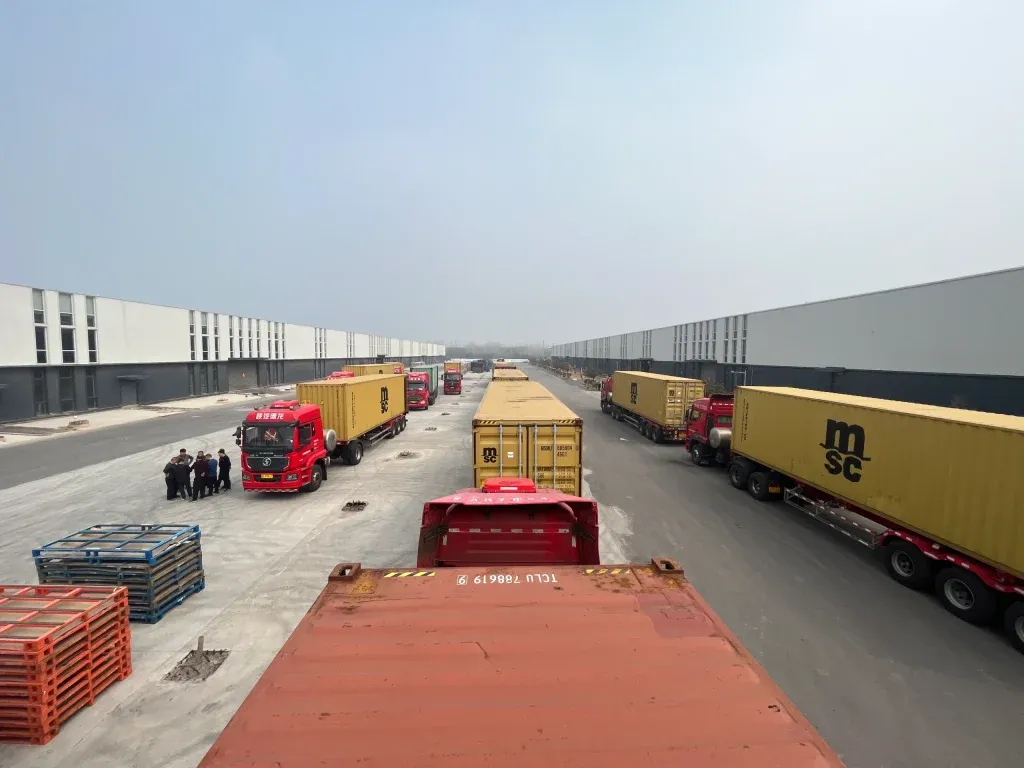
Container planning is usually done after the quote is agreed, and that is the wrong order. The number of boxes a project needs decides the freight line, the duty base, the delivery window and the handling equipment on site — and for battery projects it can decide whether the equipment can be booked at all. A buyer who knows roughly what fits can tell in ten minutes whether a quote is sane; a buyer who does not finds out when the packing list arrives.
This page is for importers, EPCs and distributors planning sea freight for a solar order. It gives the dimensions you actually plan with, the two limits that decide how much fits, per-equipment quantities with the assumptions stated, a worked mixed load, the packing specification to require, and the checks that belong before the container is sealed. Every quantity here is a planning estimate built from the assumptions shown; the numbers that bind are the packing specification from the factory and the payload your carrier will accept on the lane.
The three boxes you are choosing between
A 40HQ is a 40ft high-cube container. Compared with a 40GP it has roughly 30 cm more internal height, costs very little more to move, and that extra height is usually the difference between one pallet layer and two — or between shipping a tall cabinet and not shipping it.
Reference table
Swipe horizontally to view all columns →
| Box | Internal L × W × H | Door opening | Nominal volume | Usable payload |
|---|---|---|---|---|
| 20GP | 5.90 × 2.35 × 2.39 m | 2.34 × 2.28 m | 33 m³ | about 28,000 kg |
| 40GP | 12.03 × 2.35 × 2.39 m | 2.34 × 2.28 m | 67 m³ | about 26,700 kg |
| 40HQ | 12.03 × 2.35 × 2.69 m | 2.34 × 2.58 m | 76 m³ | about 26,500 kg |
Payload is maximum gross mass minus tare. Maximum gross is standardised at 30,480 kg, but tare varies by operator and build, and — the part that catches people — road limits on the delivery lane are frequently lower than the container’s rating. A 40ft box that is legal on the water can be over the axle limit on a US highway, which is the most common reason a loaded container has to be reworked at the port.
⚠️ What to do: get the payload figure from the carrier for the specific lane, not from a spec sheet. Then plan to it, not to the nominal volume.
The two limits, and why only one of them binds
Every load runs out of either space or mass. Whichever it is, the other one is wasted capacity you have already paid for.
- Volume limit: 76 m³ in a 40HQ, and in practice less — a well-loaded box leaves 5 to 10% unusable around doors, between pallets and above the last layer.
- Payload limit: about 26,500 kg, or whatever the lane allows.
- The break-even density: 26,500 kg ÷ 76 m³ is roughly 350 kg/m³. Packed cargo denser than that hits the weight ceiling with room to spare above it; cargo lighter than that fills the box while the weight is still nowhere near the limit.
That single number explains almost every container surprise in this industry. Solar modules are light for their packed volume and run out of floor and height. Battery cabinets are the opposite: they hit the payload ceiling with a large empty volume above them. Put the two in the same box and both halves of the capacity get used.
Modules: floor pattern and stack height bind, weight does not
Worked on a typical 450 W module — about 2,278 × 1,134 × 35 mm and about 24 kg — flat-packed on a 2.30 × 1.15 m pallet:
- Per pallet: about 30 modules, stack height about 1.20 m including the pallet. Stack height is set by stability, not by the container.
- Per layer: 10 pallets — two across the 2.35 m width, five along the 12.03 m length.
- Layers: two, because 2 × 1.20 m fits inside 2.69 m and three does not.
- Result: about 20 pallets, roughly 600 to 700 modules — call it 270 to 315 kW — using about 63 m³ of 76 and only about 15,000 kg of 26,500.
So a container of modules leaves roughly 11 tonnes of unused payload. If the factory’s pallet pattern or stack height differs — and it does differ between factories and packaging lines — the count moves by 10% or more, which is why the packing data belongs on the enquiry rather than in a guess. For the module choices behind that number, see solar modules and the B2B module buying guide.
Batteries: payload binds long before volume
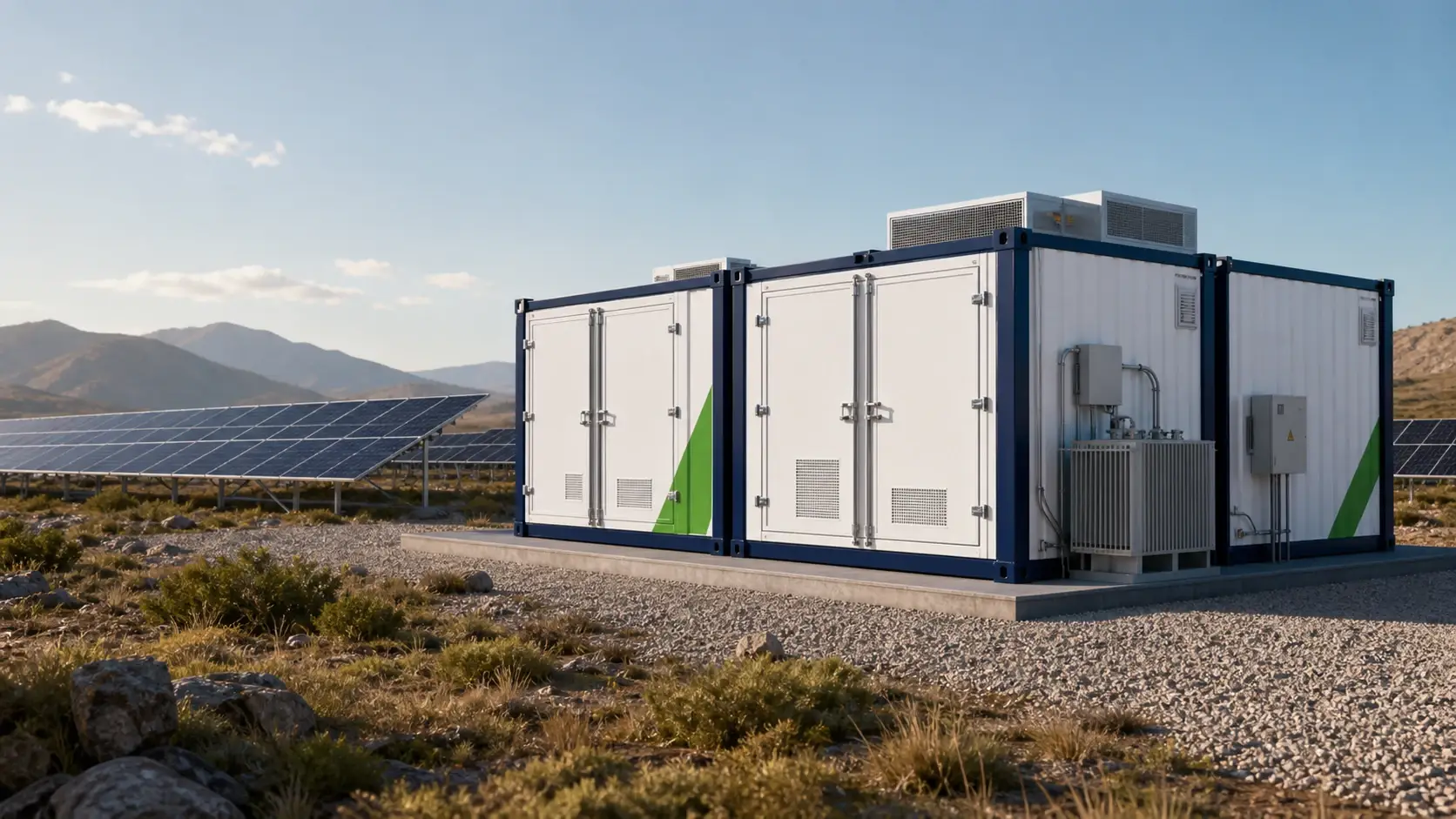
A 500 kWh cabinet is roughly 1.6 × 1.2 m on the floor, about 2.3 m tall and around 4.0 to 4.5 tonnes. That is about 930 kg per cubic metre of occupied box — nearly three times the break-even density.
- By mass: six cabinets, around 25 tonnes, is close to the ceiling.
- By geometry: floor area alone would take ten or more, and a 2.3 m cabinet clears a 2.58 m door.
- Result: roughly 6 × 500 kWh = 3 MWh per 40HQ, decided by weight. The empty space above and around the cabinets is paid for and unused unless something light goes with them.
There is a second constraint that is not about space at all. Lithium batteries travel as dangerous goods: the cabinet carries a UN number and ships under a packing instruction that sets how it is packed, labelled, documented and — depending on the mode and the instruction — what state of charge it is shipped at. That classification gates the booking. It is also the single most common reason a solar container misses its sailing, because it is usually discovered after the equipment has been built.
⚠️ What to do: confirm the UN number, packing instruction and state-of-charge requirement for the exact model before production starts, not before booking. The US-side paperwork that goes with it is set out in the import checklist. Cabinet options are under battery energy storage.
Inverters and switchgear: heavy, and awkward to lash
A 250 kW string inverter is roughly 1.1 × 0.85 × 2.05 m and around 900 to 1,000 kg — about 500 kg per cubic metre, so mass is the nearer limit. Geometry still decides in practice: ten along the length, two across, one layer only because the cabinet is taller than half the box height. Typically 18 to 22 units per 40HQ, around 5 MW.
The real issue is not count, it is securing. Tall, top-heavy units on a narrow footprint need dunnage, lashing to the container’s lashing points and a plan that keeps the mass low and spread. An inverter that arrives with a bent enclosure because it was strapped to a pallet and nothing else is a claim nobody wins.
Mounting and balance-of-system: the top-up cargo
Rails, clamps, cable and combiner boxes are light for their volume. They run out of space long before they run out of mass — which makes them the natural top-up for a container that modules or batteries have left half-empty. Practical consequences:
- Load dense items first — batteries and transformers — then modules, then racking and BOS as filler.
- Racking is the first thing to move out when a mixed box runs tight, because it is the cheapest thing to source locally or from domestic stock.
- Bundled lengths are awkward. Rails in 4 to 6 m bundles do not cube out neatly; confirm bundle length against the door opening before assuming they will go in.
Structure options are under mounting systems.
A mixed container, worked end to end
Take a 250 kW rooftop array with 500 kWh of storage, quoted as a single shipment. Using the figures above:
Reference table
Swipe horizontally to view all columns →
| Item | Quantity | Mass | Volume |
|---|---|---|---|
| 450 W modules (20 pallets) | ~600 | ~15.0 t | ~63 m³ |
| 500 kWh battery cabinet | 1 | ~4.3 t | ~4.6 m³ |
| 250 kW string inverter | 1 | ~1.0 t | ~1.9 m³ |
| Mounting and BOS | 1 lot | ~4.0 t | ~6.0 m³ |
| Total | ~24.3 t | ~75.5 m³ |
It fits — but only just, and it is volume that runs out, not weight. Move the racking out and the same box has comfortable margin; add a second battery cabinet and it does not fit at all, because mass would go over. That is the whole method in one example: find which limit you are near, then move the cargo that is cheapest to move.
Scaling up: 500 kW of modules alone is about 1,100 panels, which is two 40HQ containers with room left over in each. Add storage to a 500 kW project and you are planning batteries by mass and modules by pallets, in separate boxes, with the racking spread between them.
The packing specification to require before production
None of the quantities above survive contact with a factory that packs differently. Ask for these in writing, and treat them as part of the order:
- Pallet dimensions and units per pallet, separately for each line item.
- Maximum stack height, and whether pallets may be double-stacked.
- Pallet type — and for wood, heat-treatment marking to the international standard for wood packaging.
- Corner and edge protection, plus top sheet and stretch wrap.
- Moisture protection for a sea voyage: desiccant quantity, bag or wrap, and whether the goods are sealed.
- Lashing and dunnage method for tall, heavy units, tied to the container’s lashing points.
- Load distribution, so the mass sits spread over the floor and not concentrated over a few metres.
- Labelling that matches the commercial invoice and packing list line for line.
- A loading plan and pre-sealing photographs. If a supplier cannot show what went into the box before it closed, there is nothing to compare against when it opens.
Checks before the container is sealed
- Piece count and pallet count against the packing list, by line item.
- Pallet condition — no broken boards, no crushed corners, no leaning stacks.
- Wrap and moisture protection intact; desiccant present and not already spent.
- Lashing on every tall unit; dunnage under it; nothing free to move.
- Mass spread along the floor, heaviest over the axles, not all at the door end.
- Photographs of the load at roughly half full, at full, and of the closed doors with the seal.
- Container number and seal number recorded and matched to the bill of lading.
- Document set complete and consistent across commercial invoice, packing list and bill of lading — quantities, weights, model numbers.
- If batteries are inside: UN number, packing instruction, dangerous goods declaration and test documentation current for the exact model.
- Door clearance checked for anything taller than 2.5 m, including the pallet it sits on.
When buying from US stock removes the problem
Container planning is a sea-freight problem, and it disappears for anything that ships from domestic stock. For a US-stocked order you buy a pallet quantity and a delivery window instead: no payload arithmetic, no port dwell, no duty timing, no rework at the port because the axle limit is lower than the container rating.
It changes the economics most for the heavy items — battery cabinets, transformers, switchgear — because those are the ones where a container plan is really a mass calculation and where a port problem is expensive. A common structure is to import the volume-driven cargo and draw the weight-driven cargo from domestic stock. What is committed on either route is set out under service quality and claims.
Planning a shipment?
Send the equipment list and the destination, and the container plan comes back with the quote: pallets per box, which limit is binding, what has to move, and — where batteries are involved — the classification and documents the booking depends on. Packing data is issued per order against the factory’s specification for that line, and the loading plan and pre-sealing photographs are part of what is sent before the container closes.
BUYER CHECKLIST
Buyer considerations for this scope
Ask for the packing data with the quote, not the freight rate
Units per pallet, pallet dimensions, maximum stack height and pallets per container decide the freight line and the landed cost. A rate quoted without packing data is not a quote you can compare.
Work out which limit you are near before adding anything
Roughly 350 kg per cubic metre is the break-even density in a 40HQ. Above it you are buying volume you cannot use; below it you are buying payload you cannot use. That single check tells you what to move out and what to add.
Settle battery transport classification before production starts
The UN number, packing instruction and state-of-charge requirement gate the booking. Discovering them after the cabinets have been built is the most common reason a solar container misses its sailing.
PRACTICAL ANSWERS
Questions buyers ask about this
How many 450 W solar modules fit in a 40HQ container?
Roughly 600 to 700 — about 270 to 315 kW — flat-packed around 30 per pallet, two pallet layers high. The binding limit is stack height and floor pattern, not payload: a container of modules typically uses only about 15 of the 26.5 tonnes available.
Is a 40HQ worth the extra cost over a 40GP?
Almost always for solar. The extra 30 cm of internal height costs very little more in freight and is usually the difference between two pallet layers and one — and between shipping a 2.3 m battery cabinet and not shipping it at all.
Can battery cabinets and modules share one container?
Often yes, and it is the efficient way to load: modules run out of space with payload to spare, cabinets run out of payload with space to spare. The battery classification, packing instruction and documents must be settled before the booking, not after production.
When is a second container cheaper than consolidating?
When the added cargo is light for its volume — racking, cable, balance-of-system — and does not move the sailing date. If a second box pushes the vessel or forces a rework at the port, consolidating or drawing the top-up from US stock is usually cheaper.
EXPLORE FURTHER