
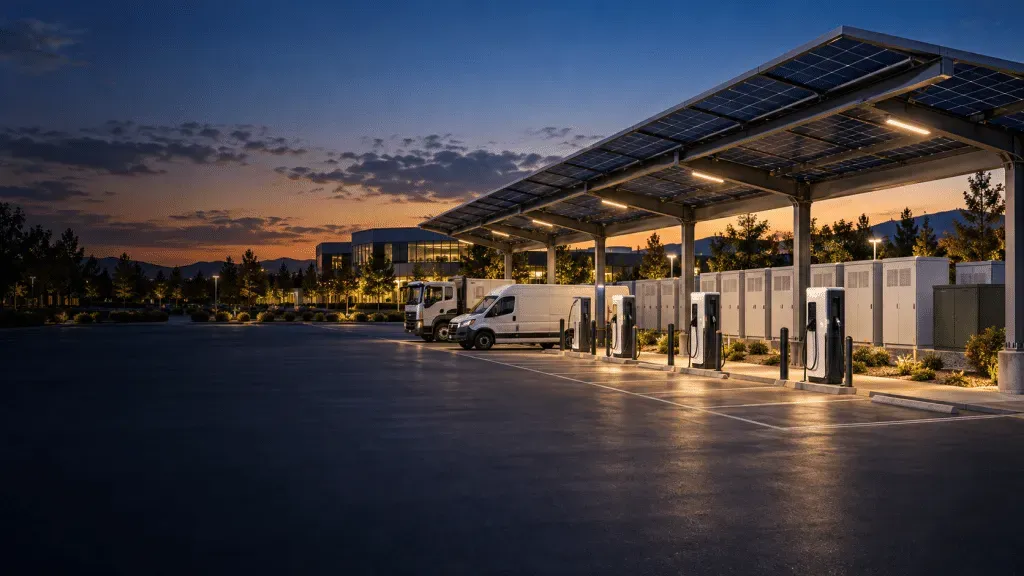
EV charging projects fail on a predictable issue: the chargers are specified first, the grid connection is discovered second, and the upgrade quote arrives third. Sites that plan the other way round – starting from what the connection can actually deliver – routinely install more charging capacity for less money.
This guide covers where solar and storage fit in that sequence, and what to specify when you do.
The connection is the constraint, not the chargers
A DC fast charging cluster can draw more power than the entire existing building it sits next to. Before selecting chargers, establish two numbers from the utility: the available capacity at the existing connection, and the cost and lead time of upgrading it. Upgrade lead times are frequently longer than the rest of the project, and in some networks the cost of the upgrade exceeds the cost of the chargers.
That is the opening for storage. A battery sized to cover the difference between what the site has and what the chargers need can defer or avoid the upgrade entirely – and deferral is often the strongest line in the business case.
Read the site's load profile before sizing anything
Charging load is nothing like building load. It is spiky, it is driven by dwell time rather than by occupancy, and it is heavily influenced by how many vehicles charge simultaneously. Three questions:
- Peak simultaneous demand – not the nameplate sum of the chargers, but the realistic maximum concurrent draw.
- Daily energy throughput – how many kWh the site will actually dispense per day.
- Dwell pattern – whether vehicles are parked for twenty minutes or for eight hours, which determines whether the site needs power or energy.
Get this wrong and you will buy a battery with the wrong shape: a large energy capacity that cannot deliver the peak, or a high-power unit that empties in twenty minutes.
Size storage to the bill, not to the chargers
On most commercial tariffs a charging site faces two separate charges, and storage attacks them differently:
- Demand charges are set by the highest sustained draw in the billing period. Shaving that peak is a power problem – the battery needs enough kW, and a controller that can act on the meter in real time.
- Energy charges are set by total consumption. Reducing them is an energy problem – the battery needs enough kWh to shift consumption away from expensive periods.
Sites dominated by fast charging are usually demand-charge problems. Sites dominated by destination and fleet charging are usually energy problems. The distinction drives the whole specification, and we cover the underlying parameters in the BESS specification guide.
Fast charging and destination charging are different projects
DC fast charging concentrates enormous power into short events – the battery is there to chop the top off a spike and protect the connection. Destination and workplace charging spreads modest power over long dwell times – the battery is there to store cheap or self-generated energy and release it steadily.
Fleet depots are a third case again: predictable overnight windows, known vehicle schedules, and often a hard deadline to have every vehicle charged by a set time. That makes them the easiest to model and the most likely to justify storage on pure operating cost.
Solar's role is smaller than it looks – and still worth it
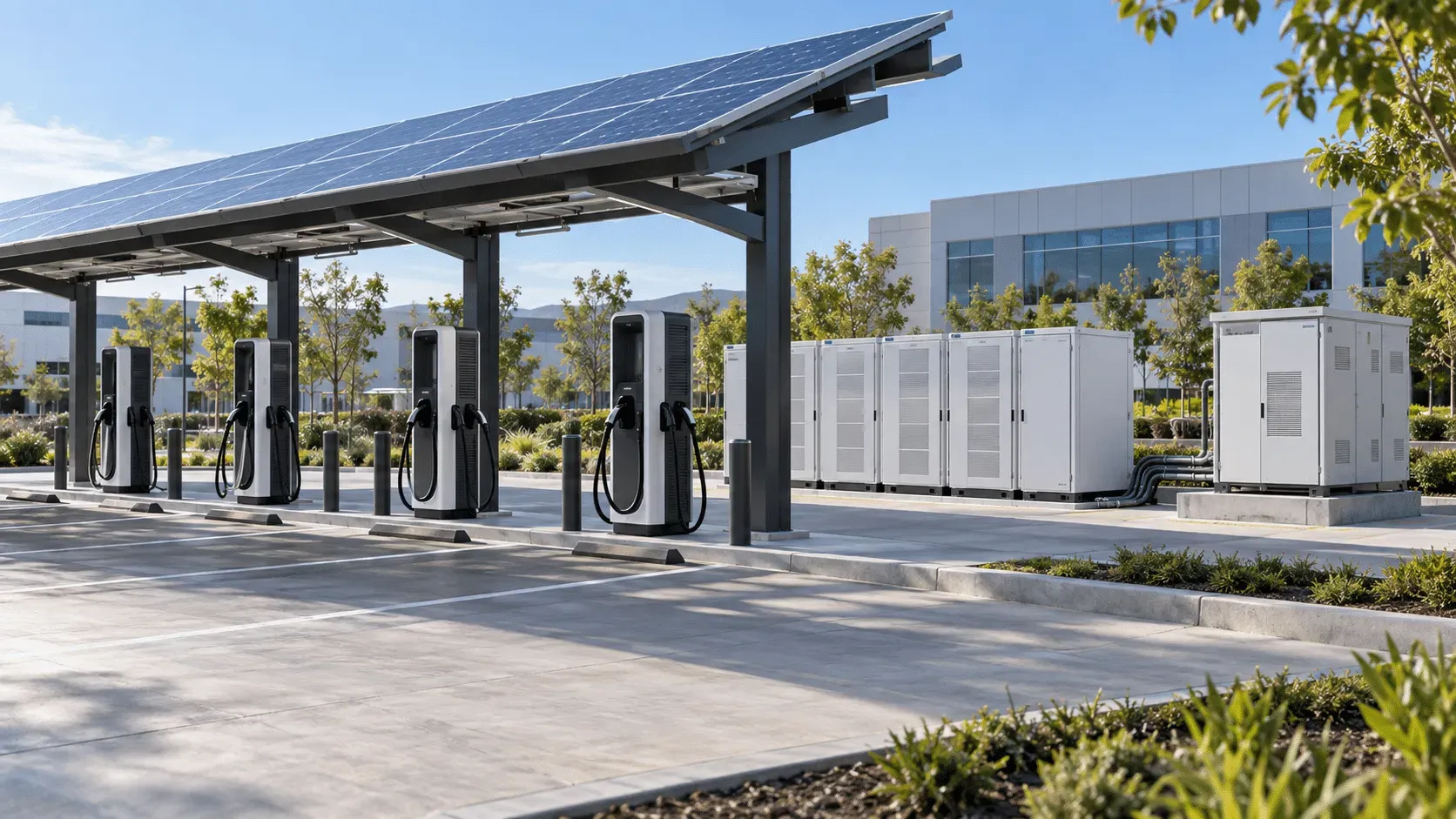
A charging site’s canopy roof area is finite, and the energy it can generate is usually a fraction of what the chargers will dispense. Solar will not run a fast charging hub on its own, and no credible model claims it will.
What it does do is three useful things: it offsets the site’s baseline building load, it reduces the daytime grid draw precisely when the site is busiest, and it makes the canopy structure do two jobs. Presented that way – as a contribution with a defined value rather than as a solution – solar survives scrutiny in a way that overstated claims do not.
The canopy is a structural project, not an accessory
If you are building carport structures, treat them as structures. Foundation type depends on ground conditions, wind and snow loads and corrosion class govern the design, and the structural calculation is the document the inspector will ask for. The same fundamentals apply as for any mounting system – we cover them in the balance of system guide. Plan the array, the drainage, the lighting and the charger cable routes together, because retrofitting any of them into a finished canopy is expensive.
What to confirm with the utility before ordering
- Available capacity at the existing connection, in writing.
- Upgrade cost and lead time if capacity is insufficient.
- Whether export is permitted, capped, or prohibited – which changes the inverter configuration.
- The demand charge structure and the interval on which it is measured.
- Any requirement for separate metering or for a dedicated connection.
The export answer matters more than people expect: if export is capped or prohibited, the inverter must support the required export control scheme, which is a specification item, not a setting.
Specification checklist
Reference table
Swipe horizontally to view all columns →
| Item | Specify | Where it goes wrong |
|---|---|---|
| Grid capacity | Available kW in writing, upgrade cost and lead time | Upgrade quoted after chargers ordered |
| Load profile | Peak concurrent draw and daily kWh | Battery sized to nameplate, not reality |
| Battery shape | kW-led for demand charges, kWh-led for energy | Right capacity, wrong power |
| Solar contribution | Modelled as offset, not as supply | Overstated in the business case |
| Canopy structure | Foundation, wind, snow, corrosion, drainage | Retrofit costs after build |
| Export control | Confirmed with utility, supported by inverter | Failed commissioning |
| Monitoring | Charger and battery data on one view | Faults diagnosed separately and slowly |
Putting a site together
Bring the utility’s capacity answer and a rough dwell profile to the first conversation and the equipment list largely specifies itself. See how these projects are configured on the EV charging and solar storage page, review energy storage and inverters and controllers, or send your site details through the contact page.
PRACTICAL ANSWERS
Questions buyers ask about this
What limits the number of chargers we can install?
The existing electrical service, not the parking layout. The available capacity at the connection usually decides how many chargers can run simultaneously, and storage or load management is what lets you install more than that.
Should storage be sized to the chargers or to the bill?
To the bill. Storage sized to the charging load alone rarely pays back. It is sized against the demand-charge profile and the peak windows in your tariff.
Do fast chargers and destination chargers change the design?
Yes, they are different projects. Fast charging creates short high peaks, which is exactly the profile storage and load management reduce. Destination charging is a long, low, predictable load that is usually cheaper to serve.
Can a canopy carry both the array and the chargers?
Yes, where the structure is designed for it. The canopy has to be engineered for the module load, the wind and snow region and the vehicle impact requirements, and the conduit route to the chargers belongs in the structural drawing rather than in an addendum.
EXPLORE FURTHER